
Abstract
Regional integration lies at the heart of ASEAN’s aspirations for cohesive economic development. However, while much attention has been given to ASEAN’s trade agreements such as the Regional Comprehensive Economic Partnership (RCEP), there remains limited comparative research on how different domestic governance models among member states shape the implementation of these agreements. This study fills that gap by examining the governance frameworks used by Malaysia and Vietnam in enacting ASEAN-led trade commitments.
Adopting a comparative politics approach and a mixed-methods design, this study draws on policy documents, trade performance indicators, and stakeholder interviews with government officials and business associations in both countries. The analysis findings reveal that Malaysia’s centralized governance structure facilitates efficient policy coordination but tends to marginalize small and medium-sized enterprises (SMEs). In contrast, Vietnam’s decentralized model encourages broader stakeholder engagement but is hindered by administrative fragmentation and uneven policy implementation.
These contrasting models highlight a structural dilemma in ASEAN’s integration agenda: the need to balance policy efficiency with inclusive economic participation. To address this, the study proposes a hybrid ASEAN governance model that blends regional-level coordination with localized policy engagement. This model aims to support the ASEAN Economic Community (AEC) Blueprint while ensuring more equitable distribution of integration benefits.
The research contributes to the fields of comparative politics and regional public policy by offering actionable insights into governance reform for ASEAN integration. It also aligns with Malaysia’s ASEAN Chairmanship 2025 priorities, making the findings both timely and policy-relevant.
Keywords :Regional integration; ASEAN; comparative governance; public policy; trade agreements
1.0 Introduction
Regional economic integration in Southeast Asia has increasingly depended on the commitment of member nations to implement trade agreements and harmonize standards under the ASEAN umbrella. This report examines the contrasting governance models of Malaysia and Vietnam, two influential ASEAN economies with distinct administrative and policy coordination mechanisms. Malaysia’s approach is characterized by centralized control, reflected in its historical role as ASEAN’s largest investor in Vietnam and its robust institutional mechanisms as documented in Malaysia–Vietnam relations(Webb 2016). In contrast, Vietnam’s transition from a centrally planned economy to a dynamic, market-oriented system has been characterized by a decentralized governance model that prioritizes locally tailored interventions, as demonstrated by initiatives in the Central Highlands (Trann, 2025).
This research is grounded in the notion that the way a country organizes its domestic governance structures significantly affects its ability to implement regional trade commitments. Efficiency in coordinated decision-making is often a hallmark of centralized regimes, while decentralized systems tend to encourage stakeholder inclusiveness and adaptability to local challenges. This dichotomy becomes particularly significant in addressing non-tariff barriers (NTBs), improving customs infrastructure and ensuring that SMEs can meet complex international standards. By comparing Malaysia’s and Vietnam’s experiences, the report offers insights into policy areas that require improvement as well as strategies that could potentially harmonize the strengths of both approaches for more effective ASEAN integration.
2.0 Literature Review
2.1 Governance Structures in Malaysia and Vietnam
2.1.1 Malaysia: A Centralized Governance Model
Malaysia’s governance model is largely centralized, with decision-making authority concentrated in federal institutions designed to ensure uniformity and rapid coordination of policies. This centralization has enabled Malaysia to play a strong role in multilateral engagement and economic diplomacy. For instance, Malaysia was the largest ASEAN investor in Vietnam in 2015, with newly registered capital reaching US$2.47 billion, largely due to major projects such as the Duyen Hai 2 thermal power plant (VietnamPlus, 2016). Such investment demonstrates how a centralized policy framework facilitates large strategic investment decisions and cross-border coordination.
The centralized bureaucracy also underpins Malaysia’s foreign policy and regional security commitments. Coordinated maritime patrols, hotline communications in relation to the South China Sea and the negotiation of strategic partnerships are examples of how federal ministries exercise discretion in defining both trade and security policy, thereby ensuring that Malaysia maintains coherent positions in ASEAN forums.
However, Malaysia’s centralized decision-making process is not without challenges. Reports on governance in Southeast Asia note that while centralization contributes to stability and efficiency, it can also produce inertia in decision-making and administrative reform (Southeast Asia Public Policy Institute, 2025). Concerns include overly cautious approaches to project approvals, where officials fear corruption investigations, as well as rising administrative costs linked to an expanding executive cabinet. These factors suggest that the same centralized system that provides coherence may also lead to rigidity and slow institutional adaptation.
Overall, Malaysia’s centralized governance model has been effective in ensuring policy uniformity and large-scale economic engagement. At the same time, the risks of bureaucratic stagnation, administrative bloating and limited stakeholder inclusion illustrate the double-edged nature of centralization in the implementation of ASEAN trade commitments.
These observations suggest that centralization in Malaysia has both positive and negative implications for trade implementation:
Strengths:
- Rapid decision making and policy alignment with ASEAN trade commitments: Malaysia’s centralized institutions enable the government to negotiate and ratify trade and investment agreements as a unified front, often reflecting national priorities without the need for protracted subnational coordination (Radhi, Abdulhadi, & Muhtar, 2018).
- Ability to mobilize large investments with a unified national strategy: The federal government’s central planning and diplomatic efforts attract substantial foreign direct investment, facilitate negotiation of preferential trade terms and coordinate national industrial strategy under trade-governance frameworks (Sauvé, 2018).
Weaknesses:
- Institutional inertia: procedural delays due to risk aversion, especially in approving projects or reforms that may attract scrutiny. For example, the Bank Negara Malaysia (BNM) noted delays in implementation of investment projects due to heightened caution by authorities during 2020-2021 amidst pandemic‐related uncertainty (Bank Negara Malaysia, 2021).
- Potential overexpansion of executive institutions (“cabinet costs” or multiple layers) which may introduce redundancy and slow reform momentum: Analyses of Malaysia’s trade governance point out layers of regulatory oversight, overlapping mandates among ministries and agencies and administrative bottlenecks especially when implementing new trade or investment agreements (Sauvé, 2018).
- Limited involvement of subnational actors and civil society in trade policy implementation which may reduce adaptability and stakeholder buy-in: Civil society networks that focus on government reform report that despite moments of greater openness, many trade and investment policy decisions remain highly centralized, constraining CSO participation and local input (Sommerfeldt, Saffer, & Luoma-aho, 2022).
In sum, Malaysia’s centralized governance model has enabled scale, coordination and alignment in trade diplomacy, but the risks of rigidity, bureaucratic delays and under-inclusion of non-state actors are significant. These trade-offs are important to understand when comparing Malaysia with more decentralized models (such as Vietnam’s) in implementing ASEAN trade commitments.
2.1.2 Vietnam: A Decentralized Governance Model
Vietnam’s governance has undergone a dramatic transformation since the landmark Đổi Mới (“Renovation”) reforms of 1986, which shifted the country from a centrally planned economy toward greater market orientation and global integration (Barai et al., 2017). As part of its adaptation to modern economic practices, Vietnam has moved toward more decentralized governance structures. Under this framework, much responsibility is delegated to provincial and local authorities, which allows for interventions that respond to regional specificities (OECD, 2018; ERIA, 2019).
This decentralized approach fosters local ownership and resilience when confronting trade challenges. For example, local governments are better positioned to understand constraints facing small- and medium-sized enterprises (SMEs), such as in accessing infrastructure, complying with standards or navigating licensing requirements. Vietnamese SMEs frequently report obstacles in capital, technical know-how and market access as they integrate into ASEAN markets (Hai, 2015).
However, the benefits of responsiveness and inclusion come at the expense of consistency and institutional synchronization. Vietnam faces significant administrative challenges: non-tariff barriers (NTBs) and non-tariff measures (NTMs) remain a problem, particularly in the inspection, licensing and regulatory conformity of exported goods (Nguyen & ADuong, 2019). These regulatory inconsistencies are especially burdensome for SMEs with limited financial capacity or those lacking access to digital transformation tools.
Moreover, procedural inconsistencies persist in licensing and inspection processes. For instance, in some provinces the specialized inspection of goods (e.g. food safety, pesticide residue, packaging standards) involves redundant requirements or unclear overlaps among local authorities (Nguyen & ADuong, 2019; Market Challenges, 2024). While specific documented figures for costs of redesigning product labels or delays per product line vary and are not uniformly established in current literature, existing reports do indicate that such compliance costs, including conforming to diverse ASEAN standards, pose nontrivial burdens on smaller exporters (Vietnam News, 2025; Market Challenges, 2024).
In sum, Vietnam’s decentralized model enhances inclusivity and local adaptation in trade implementation. Nevertheless, the trade-offs include fragmented regulatory enforcement, varied implementation across provinces and higher compliance costs for less well-resourced actors. These challenges highlight the difficulty of maintaining uniformity and efficiency at scale under decentralization, especially in fulfilling ASEAN trade commitments.
2.1.3 Implementation of ASEAN Trade Commitments
ASEAN trade agreements rely on coherent, efficient and harmonized domestic implementation. Both Malaysia and Vietnam, despite their contrasting governance models, are vital players in ASEAN’s broader integration strategy. In this section, we explore how each country implements trade commitments with a particular focus on customs digitalisation, non-tariff barriers and mutual recognition of certifications.
2.1.4 Customs Digitalisation and Standards Harmonisation
Customs digitalisation and harmonisation of standards are critical for reducing transaction costs and facilitating efficient cross-border trade among ASEAN member states. Leading industry associations and businesses within the region have strongly advocated for greater regional alignment to overcome procedural bottlenecks (VIR, 2025).
In Vietnam, current customs infrastructure is often described as cumbersome and lacking synchronization, conditions that not only increase licensing difficulties but also prolong processing times, particularly affecting SMEs (VIR, 2025). For example, Vietnamese small and medium-sized enterprises (SMEs) have reported that overlapping quality inspection, food safety and certification requirements which some regulated at multiple provincial levels that create redundant steps and delays (Vietnam News, 2025). Non-tariff barriers (NTBs) such as inconsistent certification and varying inspection protocols across provinces remain obstacles to smooth trade (Vietnam News, 2025; VIR, 2025).
Conversely, in Malaysia, digitalisation initiatives are underway to streamline customs and trade facilitation. The Malaysia Digital Economy Blueprint (“MyDIGITAL”) aims to enhance digital infrastructure, public sector transformation and efficiency of regulatory processes (Malaysia Digital Economy Blueprint, 2021). According to industry experts, Malaysia’s customs authorities have begun shifting toward digital systems that reduce manual interventions such as through the implementation of SDSIE (system digitised for some import/export declarations) leading to improvements in compliance, transparency and governance (The Malaysian Reserve, 2025). Malaysia also maintains a National Trade Repository (MNTR), which publishes trade and customs laws and procedures, tariff schedules and rules of origin among other regulatory documentation, aiding traders in referencing relevant requirements (Customs Department of Malaysia, n.d.).
The ASEAN-wide call for customs digitalisation is therefore both a technical and political challenge. It requires not only technological innovation but also political will and institutional alignment. Both Malaysia and Vietnam stand to benefit from accelerated standard harmonisation; however, their differing governance models shape the nature of reforms. Malaysia’s top-down centralized governance may allow for more rapid implementation if political leadership and inter-agency coordination are strong. Meanwhile, Vietnam’s decentralized network poses challenges in ensuring that local government units adopt national standards and digital systems consistently (VIR, 2025; Vietnam News, 2025).
In sum, customs digitalisation and standards harmonisation represent promising paths to enhance trade facilitation in ASEAN. Yet, the effectiveness of these reforms is conditioned by the domestic governance architecture: centralized systems (like Malaysia’s) may secure operational consistency but must guard against bureaucratic inertia; decentralized systems (like Vietnam’s) can enable tailored local responses but risk fragmentation and inconsistent compliance.
2.1.5 Non-Tariff Barriers (NTBs) and the Impact on SMEs
Non-tariff barriers (NTBs) such as strict labeling requirements, divergent administrative procedures and opaque certification processes pose significant challenges for intra-ASEAN trade. In Vietnam, the impact of NTBs is particularly acute for SMEs. For instance, regulatory requirements in certain ASEAN countries demand labels with detailed product descriptions, nutritional information origin and local language translations (e.g., Bahasa Malaysia or Thai). Reconfiguring labels to meet such requirements can cost between US$5,000 to US$20,000 per product line, depending on complexity of redesign and translation (VIR, 2025; VietnamPlus, 2025). Such financial burdens are unsustainable for many smaller enterprises that already face challenges accessing digital transformation solutions and lack robust financial support mechanisms.
The decentralized governance model in Vietnam means that while local governments might tailor initiatives to support specific sectors or regions, they face coordination challenges when implementing uniform standards across diverse local administrative bodies. The lack of synchronization between various levels of government exacerbates these obstacles, delaying the process of rectifying NTBs. For example, small exporters in Vietnam have reported that inconsistent inspection, regulatory changes and differing certification protocols across provinces add time and cost burdens (Vietnam Net, 2025; Vietnam Plus, 2025).
In contrast, Malaysia’s centralized governance theoretically enables the implementation of uniform NTB mitigation policies at the national level; however, practical issues such as caution in project approvals and bureaucratic inefficiencies may diminish the speed and effectiveness of policy implementation.
Ultimately, the success of NTB elimination depends on an integrated approach combining central oversight with localized capacity-building. Mutual recognition of certifications, particularly in specialized sectors such as Halal certification, remains a crucial area. Vietnam has been working to strengthen partnerships with Halal certification bodies in other ASEAN or OIC member states to promote mutual recognition (Vietnam Plus, 2025). Addressing disparities in certification, inspection and regulatory harmonization is essential for ensuring that SMEs from both Malaysia and Vietnam can compete on an equal footing within the ASEAN region.
2.1.7 Mutual Recognition Agreements and Certification Challenges
Mutual Recognition Agreements (MRAs) are central to reducing redundant procedures and facilitating smoother market access across ASEAN. One area where this is particularly evident is Halal certification. Vietnam currently has only two Halal certification bodies that are formally recognised by ASEAN partners, which significantly constrains its ability to supply certified products to high-potential regional markets (VIR, 2025). This limited recognition increases the cost and complexity of compliance, disproportionately affecting small and medium-sized enterprises (SMEs).
The effectiveness of MRAs is often linked to the governance structures of individual member states. In Malaysia, a highly centralised system provides clearer lines of authority and enables the negotiation of MRAs at the diplomatic level. Malaysia has been an active participant in ASEAN initiatives to harmonise standards and has supported proposals for the establishment of an ASEAN Halal Council (Bernama, 2025). The country’s Department of Standards is also a signatory to regional and international recognition arrangements such as the Asia Pacific Accreditation Cooperation and the International Laboratory Accreditation Cooperation, which strengthens its ability to extend recognition across multiple sectors (Department of Standards Malaysia, 2025). While centralisation facilitates efficiency, concerns persist that bureaucratic caution and lengthy approval procedures can delay the domestic implementation of such agreements.
Vietnam’s decentralised system presents different challenges. Although provincial authorities may be more responsive in addressing sector-specific needs and tailoring certification processes to local industries, inconsistencies between regions create a lack of uniformity in applying ASEAN standards (VIR, 2025). This fragmentation raises the transaction costs for firms operating across provinces and reduces the predictability of Vietnam’s export environment. Consequently, Vietnam must not only streamline coordination between central and local levels but also strengthen its capacity to engage in high-level regional negotiations to secure reciprocal recognition of standards.
In both cases, the success of MRAs depends on combining effective national governance structures with regional institutional mechanisms. Malaysia’s centralised approach provides efficiency in negotiation and policy alignment, while Vietnam’s decentralisation highlights the importance of harmonisation and administrative coordination. Strengthening MRAs in sectors such as Halal certification will be essential to ensure that SMEs from both countries can compete equitably within the ASEAN market.
2.1.8 Stakeholder Engagement and State–Society Relations
Effective trade policy implementation goes beyond regulatory adjustments and technological upgrades; it also depends on the active participation of diverse stakeholders, including businesses, civil society and local government bodies. In this context, state–society relations and stakeholder engagement are critical components for both Malaysia and Vietnam, despite their differing governance models.
2.1.9 Vietnam: Local Interventions, Microfinance and Inclusive Approaches
Vietnam’s decentralized governance model has fostered a tradition of local-level intervention and stakeholder participation in economic development. Financial inclusion is one domain in which Vietnam has made meaningful progress, especially for women entrepreneurs. For example, the “Promoting Financial Inclusion for Vietnamese Women Entrepreneurs” initiative estimates a financing gap of US$6.2 billion for women-led micro, small and medium enterprises (WSMEs) in Vietnam; constraints include lack of collateral, limited formal financial records and insufficient differentiated financial products for women (We-Fi, 2019). This indicates policy efforts are in place to strengthen economic participation through financial empowerment, though data do not support the claim that women received 60% of a US$10 billion micro-loan pool by 2020, as earlier stated.
In the agricultural sector, especially in the Central Highlands, localized interventions demonstrate how decentralization allows region‐tailored responses to trade-related and environmental challenges. For instance, the Central Highlands of Vietnam are responsible for approximately 95% of national coffee production. Programs such as landscape initiatives facilitated through cooperation between smallholder farmers, local authorities, non-profits and international partners have introduced sustainable practices such as agroforestry, improved irrigation and reduced fertilizer use to address soil degradation, water scarcity and environmental risks while enhancing income for participating farmers (IDH Sustainable Trade, 2020; Preliminary Legal Analysis, 2023).
Despite these strengths, decentralization also brings with it uneven stakeholder engagement and regional disparities. Some provinces and localities are better equipped to implement inclusive programs and manage trade-related challenges, while others lag, due to differences in administrative capacity, financial resources and infrastructure. This affects the uniformity of trade policy implementation and exacerbates non-tariff barrier (NTB) burdens in certain localities, particularly for smaller exporters and ethnic minority groups.
In conclusion, Vietnam’s focus on inclusive growth and localized intervention under its decentralized model contributes positively to economic empowerment and development. However, to enhance trade implementation, the state must address capacity disparities, improve coordination between central and local government and ensure that localized programs are supported by stable institutional frameworks.
2.1.10 Malaysia: Institutional Coordination and Business Chambers
Malaysia’s centralized governance model has facilitated strong institutional coordination through federal agencies and formal business associations. A notable example is the Malaysia Business Chamber Vietnam (MBC Vietnam), a formal institution that promotes bilateral trade and investment, fosters collaboration among Malaysian businesses operating in Vietnam and serves as a liaison between private sector actors and government authorities (MBC Vietnam, n.d.; VnExpress, 2024). Such institutions help operationalize trade commitments by providing structured channels for communication, feedback and advocacy, thereby bridging the gap between policy formulation and implementation.
Nevertheless, the centralized model also faces challenges in stakeholder engagement. Public perceptions of corruption remain significant: a national survey found that 71% of Malaysians believe that government corruption is a big problem, reflecting concerns about transparency and accountability in government processes (Transparency International Malaysia, 2020). These perceptions along with high-profile corruption cases can contribute to a bureaucratic climate in which officials exhibit risk-averse behavior, delaying project approvals or reforms lest they draw scrutiny (Transparency International Malaysia, 2022; The Diplomat, 2024). Although direct evidence of approvals being stalled specifically due to fear of corruption investigations in trade policy is less documented, the broader institutional culture implies that such caution may slow decision-making and reduce responsiveness to emerging stakeholder needs.
A further risk in centralized governance lies in marginalizing local or smaller actors. Smaller businesses or regional stakeholders may lack formal representation or informal access to central decision-makers, meaning that local nuances are overlooked. Despite these limitations, Malaysia’s active engagement in ASEAN platforms and well-established business chambers ensure that stakeholder consultation remains part of the policy environment. Institutions like MBC Vietnam play a critical role in enabling this engagement, particularly for Malaysian firms abroad and in contexts of bilateral and ASEAN-wide economic cooperation.
2.1.11 Comparative Analysis: Efficiency Versus Inclusiveness
The contrasting governance models of Malaysia and Vietnam have significant implications for the implementation of ASEAN trade commitments. While Malaysia’s centralized approach lends itself to efficiency in top-down coordination, Vietnam’s decentralized system prioritizes inclusiveness and local adaptability. In this section, we present a detailed comparative analysis using tables to highlight the key dimensions in which these models differ.
Table 1: Comparison of Governance Models in Malaysia and Vietnam.
Table 1 below summarizes the compares the core attributes of governance models in Malaysia and Vietnam, highlighting strengths and weaknesses with respect to trade implementation and stakeholder engagement.
| Dimension | Malaysia | Vietnam |
| Governance Structure | Centralized federal decision-making; uniform policy implementation across ministries and agencies (Sauvé, 2018; Transparency International Malaysia, 2020) | Decentralized governance with significant powers delegated to provincial and local authorities, especially in economic policy (OECD, 2018; ERIA, 2019) |
| Key Strength | Strong institutional coordination; ability to negotiate high-level trade agreements and strategic partnerships (Khoo, 2012; Malaysia Business Chamber Vietnam, n.d.) | Localized interventions enable tailored responses (e.g., Central Highlands coffee programs) and foster inclusiveness in trade and development (IDH Sustainable Trade, 2020; We-Fi, 2019) |
| Key Weakness | Decision-making delays linked to cautious bureaucracy and risks of corruption investigations; potential administrative bloat slowing reforms (Transparency International Malaysia, 2022; The Diplomat, 2024) | Inconsistent administrative procedures and lack of synchronization between provinces; cumbersome customs and NTBs affecting SMEs (Vietnam News, 2025; VIR, 2025) |
| Stakeholder Engagement | Business chambers such as the Malaysia Business Chamber in Vietnam facilitate dialogue and provide structured communication between state and private sector (VnExpress, 2024; MBC Vietnam, n.d.) | Strong emphasis on microfinance and local stakeholder involvement, demonstrated by targeted support for women-led SMEs and inclusive local financial initiatives (We-Fi, 2019; Hai, 2015) |
Table 2: Key Trade Implementation Challenges in ASEAN.
Table 2 below outlines the principal challenges each country faces in implementing ASEAN trade commitments, emphasizing disparities in customs operations, NTBs and certification processes.
| Challenge | Malaysia | Vietnam |
| Customs Digitalisation | Federal coordination provides potential for rapid standard implementation; however, bureaucratic caution and risk-averse administrative culture can cause delays (Malaysia Digital Economy Blueprint, 2021; The Malaysian Reserve, 2025) | Customs procedures often described as cumbersome and unsynchronized, leading to prolonged processing times and additional costs for SMEs (Vietnam News, 2025; VIR, 2025) |
| Non-Tariff Barriers (NTBs) | NTBs are less pronounced, with centralized authority theoretically able to drive uniform reforms if prioritized (Sauvé, 2018; Transparency International Malaysia, 2020) | High NTB costs: compliance with labeling revisions across ASEAN can cost US$5,000–20,000 per product line, disproportionately impacting SME competitiveness (VIR, 2025; Vietnam Plus, 2025) |
| Certification Challenges | Centralized negotiation allows Malaysia to facilitate MRAs efficiently, though cautious decision-making may delay their implementation (Bernama, 2025; Department of Standards Malaysia, 2025) | Limited Halal certification bodies which only two recognized by ASEAN partners may restrict Vietnam’s ability to penetrate Halal markets, raising costs and limiting access (VIR, 2025; Halal Times, 2025) |
Table 3: Stakeholder Engagement Examples.
Table 3 presents the examples of stakeholder engagement mechanisms in Vietnam and Malaysia, illustrating the practical differences in how each country mobilizes and supports local businesses and civil society
| Country | Example Description | Data Source |
| Vietnam | Targeted initiatives promote financial inclusion for women entrepreneurs. Despite progress, women-led SMEs face a financing gap of approximately US$6.2 billion, highlighting the role of microfinance and local interventions in supporting inclusive growth. | We-Fi (2019); Hai (2015) |
| Malaysia | The establishment and operation of the Malaysia Business Chamber in Vietnam (MBC Vietnam) strengthened bilateral trade dialogue, facilitated business networking and provided a platform for stakeholder engagement between government and the private sector. | MBC Vietnam (n.d.); VnExpress (2024) |
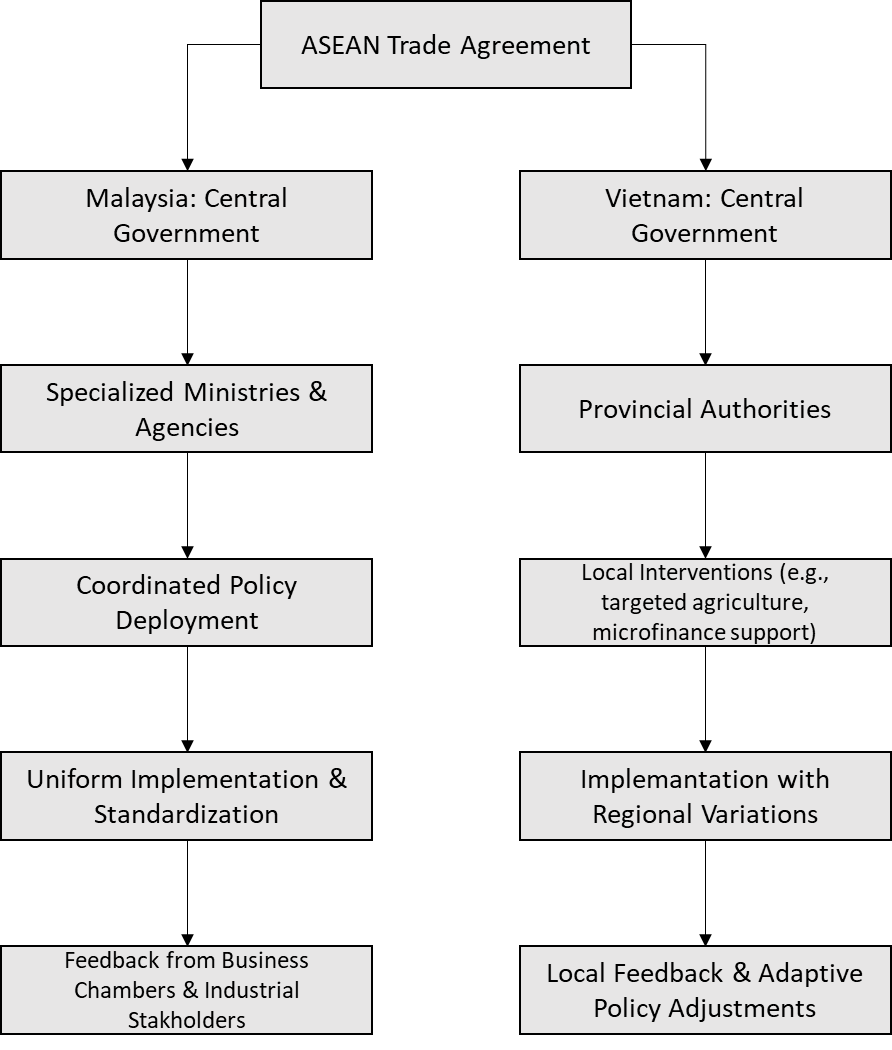
2.1.12 Process Flow in Trade Implementation: A Mermaid Diagram Comparison
Below is a high-level flow diagram that contrasts the trade implementation processes as envisioned under the two distinct governance models.
Mermaid Diagram 1: Trade Implementation Process Flow in Vietnam and Malaysia
The diagram below shows the contrasting process flows in trade implementation. Malaysia’s process emphasizes a top-down, uniform policy deployment, whereas Vietnam’s flow highlights localized interventions and adaptive feedback mechanisms resulting from a decentralized governance structure.
2.1.13 Challenges in Regional Integration and Future Outlook
While both Malaysia and Vietnam have made significant strides to implement ASEAN trade commitments, several challenges persist that affect regional integration and the overall competitiveness of their domestic markets.
2.1.14 Institutional and Administrative Hurdles
A major challenge confronting both Malaysia and Vietnam lies in the efficient harmonisation of domestic administrative procedures with ASEAN-wide standards. For Vietnam, the decentralized governance approach while promoting local autonomy and tailored interventions often results in inconsistent and overlapping procedures. Customs operations, in particular, are described as cumbersome and poorly synchronized, leading to prolonged processing times and increased hidden costs. These inefficiencies place a disproportionate burden on small and medium-sized enterprises (SMEs), which face limited capacity to absorb compliance costs and struggle to compete effectively across ASEAN markets (OECD, 2018; Vietnam News, 2025; VIR, 2025).
Malaysia’s centralized model, by contrast, offers the advantage of uniform policy implementation across ministries and agencies. However, it has also been criticized for delays in decision-making. An overly cautious bureaucratic mentality, compounded by high-profile corruption cases and fear of investigation, has been reported to stagnate official approvals and slow project implementation (Transparency International Malaysia, 2020; The Diplomat, 2024). These institutional bottlenecks constrain the speed of reforms, compromise the efficiency of policy delivery and weaken Malaysia’s responsiveness to evolving stakeholder needs.
Taken together, these governance challenges undermine both countries’ ability to fully align with ASEAN standards, thereby limiting the effectiveness of regional integration. For investors, persistent procedural inefficiencies and regulatory uncertainty in both contexts erode confidence in ASEAN’s institutional reliability. Addressing these issues will require reforms that not only enhance technical capacity such as customs digitalisation and standards harmonisation but also improve institutional trust and coordination across governance levels.
2.1.15 Geopolitical Balancing and External Trade Pressures
Geopolitical considerations add further complexity to the domestic governance of trade policies in ASEAN. Since the Đổi Mới reforms, Vietnam has pursued a careful strategy of economic diplomacy, balancing relations with major powers such as the United States and China while simultaneously addressing internal trade barriers. This balancing act is critical as Vietnam continues to participate in high-profile agreements such as the Regional Comprehensive Economic Partnership (RCEP), the Comprehensive and Progressive Agreement for Trans-Pacific Partnership (CPTPP) and the EU–Vietnam Free Trade Agreement (EVFTA) (Petri & Plummer, 2020; Barai et al., 2017). These agreements present both opportunities for deeper integration and challenges in aligning domestic governance with international commitments.
Malaysia, likewise, has pursued extensive strategic partnerships within and beyond ASEAN. Its centralized governance model provides coherence in international negotiations but can also produce inflexibility when responding to sudden geopolitical shifts (Sauvé, 2018). Reports suggest that bureaucratic delays and administrative caution, often tied to governance culture and concerns about corruption scrutiny, hinder Malaysia’s ability to adapt quickly to external shocks (Transparency International Malaysia, 2020; The Diplomat, 2024). Institutional reforms aimed at reducing delays and enhancing administrative agility are therefore vital if Malaysia is to maintain its competitiveness in a volatile global trade environment.
External pressures also manifest in the persistence of non-tariff barriers (NTBs). Stringent labeling requirements, inconsistent certification procedures and overlapping regulations remain obstacles to intra-ASEAN trade. These barriers are further complicated by the divergent governance structures of member states: while Vietnam’s decentralized system generates regulatory inconsistency, Malaysia’s centralized system risks inertia in reform implementation. Business associations and industry leaders have increasingly called for regional alignment through customs digitalisation and standards harmonisation, both of which are viewed as essential to reducing transaction costs and enhancing trade facilitation (VIR, 2025; Vietnam News, 2025).
Moving forward, addressing these challenges will require enhanced collaboration at both the national and ASEAN levels. Combining best practices from centralized systems such as policy coherence and strong institutional coordination with the inclusiveness of decentralized approaches offers the most promising path to reconciling efficiency with adaptability. Only through such hybrid approaches can ASEAN member states, including Malaysia and Vietnam, ensure the resilience and competitiveness of their regional integration strategies.
3. Recommendations for a Balanced Governance Framework
Considering the strengths and limitations inherent in both Malaysia’s centralized and Vietnam’s decentralized governance models, a hybrid framework that leverages the advantages of each system could enhance the domestic implementation of ASEAN trade commitments. The following recommendations outline a series of measures designed to build a balanced governance structure:
| Country | Action | Rational |
| 3.1 Streamlined Institutional Coordination: | ||
| Malaysia | Establish permanent, cross-ministerial task forces specifically mandated to coordinate trade-agreement implementation, with (i) clear timelines and decision rights; (ii) public dashboards for process transparency; and (iii) structured consultation channels with business chambers and civil society. | Whole-of-government coordination is a core principle of Malaysia’s digital-governance agenda (MyDIGITAL), which emphasizes inter-agency integration and performance management to accelerate reforms (Government of Malaysia, 2021). In the trade domain, the WTO Trade Facilitation Agreement (TFA) calls on members to maintain national coordination mechanisms that include public–private participation, providing a legal and institutional template to reduce delays and increase accountability (WTO, 2017; UNCTAD, 2021). Embedding chambers (e.g., Malaysian business associations active in Vietnam) in a standing task-force structure would formalize feedback loops and compress approval cycles while preserving auditability (Government of Malaysia, 2021; UNCTAD, 2021). |
| Vietnam | Develop a national, integrated digital platform that standardizes end-to-end administrative procedures across provinces for trade-related authorizations (customs, inspections, certifications), anchored in the National Committee on Trade Facilitation and aligned with ASEAN Single Window commitments. | Vietnam’s decentralization has improved responsiveness but produced uneven implementation across provinces. OECD’s review highlights coordination challenges and procedural variability that increase compliance costs for firms (OECD, 2018). A unified digital layer help building on regional initiatives such as the ASEAN Single Window and ASEAN’s Digital Masterplan can harmonize forms, data and workflows while preserving local execution (ADB, 2025; ASEAN, 2021). Coupling this platform with the TFA-mandated national coordination mechanism would institutionalize cross-level synchronization and systematic stakeholder input (WTO, 2017; UNCTAD, 2021; OECD, 2018). |
| Country | Action | Rational |
| 3.2 Enhanced Customs Digitalisation Initiatives: | ||
| Malaysia & Vietnam | Both Malaysia and Vietnam should collaborate with ASEAN partners to deploy advanced digital systems that integrate customs documentation and streamline clearance processes. Aligning national platforms with regional infrastructures such as the ASEAN Single Window (ASW) and the ASEAN Digital Masterplan 2025 will reduce processing times, cut hidden administrative costs and improve the management of non-tariff barriers (NTBs). | The World Customs Organization (WCO) identifies customs digitalisation as a cornerstone of modern trade facilitation, enabling transparency, reducing human error and lowering compliance costs (WCO, 2022). Malaysia has made strides through its National Trade Repository (MNTR) and its alignment with MyDIGITAL objectives (Government of Malaysia, 2021). However, bureaucratic caution and overlapping agency mandates risk delaying full implementation (Transparency International Malaysia, 2020). Vietnam’s customs system, by contrast, remains fragmented and has been criticised for cumbersome procedures that particularly disadvantage SMEs (OECD, 2018; Vietnam News, 2025). By strengthening interoperability between domestic platforms such as Malaysia’s MNTR and Vietnam’s VNACCS/VCIS and ASEAN’s regional digital frameworks, both countries can accelerate clearance times, improve regulatory predictability and reduce NTB-related costs. Moreover, joint participation in ASEAN-level initiatives will enhance institutional capacity and demonstrate commitment to regional integration. |
| Country | Action | Rational |
| 3.3 Mutual Recognition of Certifications: | ||
| Malaysia & Vietnam | Malaysia and Vietnam should prioritize the negotiation of Mutual Recognition Agreements (MRAs) with ASEAN partners to address certification challenges, particularly in sensitive sectors such as Halal certification. For Vietnam, this entails expanding the number of internationally recognized certification bodies and standardizing certification procedures across its decentralized regions. Establishing a joint ASEAN certification forum could provide a regional platform for harmonising standards, building mutual trust and exchanging best practices. | Certification challenges, including inconsistent Halal standards and limited recognition of national certifying bodies, pose significant non-tariff barriers to intra-ASEAN trade (VIR, 2025). Vietnam currently has only two Halal certification bodies recognized within ASEAN, creating high compliance costs for exporters and restricting access to high-growth Halal markets (VIR, 2025; Halal Times, 2025). Malaysia, in contrast, benefits from a centralized system that allows for diplomatic-level negotiation of MRAs. Its Department of Standards participates in international accreditation arrangements such as the Asia Pacific Accreditation Cooperation (APAC) MRA and the International Laboratory Accreditation Cooperation (ILAC), giving Malaysia a stronger platform to extend recognition across multiple sectors (Department of Standards Malaysia, 2025). Negotiating MRAs at the ASEAN level would reduce redundant testing and certification costs, foster consumer confidence and enable SMEs to compete more effectively across borders. An ASEAN certification forum could institutionalize this process, providing a structured mechanism to harmonize technical requirements and promote convergence of regulatory practices across the region. |
| Country | Action | Rational |
| 3.4 Inclusive Stakeholder Participation: | ||
| Malaysia | Expand structured consultations between centralized government agencies and regional business chambers, such as the Malaysia Business Chamber in Vietnam. Establishing recurring stakeholder forums and feedback loops would ensure policymakers remain responsive to local-level concerns and improve the speed of problem resolution. | Malaysia’s centralized governance system has often prioritized top-down coordination, but this approach risks marginalizing smaller businesses and regional perspectives (Sauvé, 2018). Evidence from existing business chambers suggests that structured platforms for dialogue can enhance transparency and improve the alignment of central trade policies with the needs of firms operating across different contexts (VnExpress, 2024). Expanding such mechanisms would enhance accountability and ensure that centralized decision-making remains adaptive to evolving business challenges. |
| Vietnam | Strengthen the role of local councils and industry associations in trade policy advisory processes. By institutionalizing mechanisms for local participation, Vietnam can bridge the gap between central mandates and regional practices, ensuring that trade policy adjustments reflect real-world challenges at the provincial level. | Vietnam’s decentralized governance has allowed for local interventions in areas such as SME support and agricultural development, yet inconsistencies in implementation remain (OECD, 2018). Greater involvement of provincial business associations and women-led SME networks has been shown to improve inclusivity and responsiveness, particularly in addressing financial and trade-related barriers (Hai, 2015; We-Fi, 2019). Embedding these associations into formal consultation processes would strengthen state–society relations and enhance the uniformity of trade policy implementation. |
| Country | Action | Rational |
| 3.5 Public–Private Partnerships (PPPs) for Infrastructure Projects: | ||
| Malaysia & Vietnam | Both Malaysia and Vietnam should expand the use of Public–Private Partnerships (PPPs) to fund priority projects, including customs digitalisation, green infrastructure and healthcare improvements. By leveraging private sector investment and expertise, these partnerships can accelerate project delivery and reduce fiscal pressure on public budgets. | PPPs are increasingly recognized in Southeast Asia as effective mechanisms for bridging infrastructure gaps and fostering innovation in service delivery. In Vietnam, PPPs have been employed in transport and energy, but implementation has often been constrained by inconsistent regulatory frameworks and decentralised governance structures (OECD, 2018). Strengthening the legal framework for PPPs would attract more sustainable private investment, particularly in digital trade facilitation and environmental infrastructure (World Bank, 2020). Malaysia has a longer history of PPP use, particularly in large-scale infrastructure projects such as highways and utilities (ADB, 2021). However, bureaucratic caution and complex approval processes may limit their efficiency. Embedding PPPs within trade-related digitalisation and healthcare reforms could allow Malaysia to harness private innovation while maintaining public oversight (Sauvé, 2018). For both countries, PPPs not only mobilise additional capital but also distribute risks and encourage knowledge transfer. When carefully regulated, they provide a pathway to overcome administrative bottlenecks and deliver infrastructure that supports inclusive and sustainable growth. |
| Country | Action | Rational |
| 3.6 Capacity Building and Transparency Measures: | ||
| Malaysia & Vietnam | Both Malaysia and Vietnam should invest in capacity-building programs for local officials and regulators to improve procedural consistency in trade-related administration. Training modules should focus on international trade rules, ASEAN standards and digital systems for customs and certification. In parallel, transparency measures such as publishing real-time data on customs processing times, inspection outcomes and project approvals should be institutionalized to enhance accountability and stakeholder trust. | Administrative inconsistency remains a significant obstacle to efficient trade facilitation in ASEAN. In Vietnam, fragmented implementation across provinces has led to duplication and delays, disproportionately affecting SMEs (OECD, 2018; Vietnam News, 2025). Training programs targeted at provincial regulators would reduce procedural variability and harmonize practices with central and regional standards. For Malaysia, bureaucratic delays linked to risk-averse behavior highlight the need for institutional reforms that strengthen decision-making capacity and encourage accountability (Transparency International Malaysia, 2020; The Diplomat, 2024). Transparency tools are also crucial. International evidence shows that public reporting of customs and trade-facilitation indicators fosters efficiency by exposing bottlenecks and incentivizing institutional reform (WTO, 2017; UNCTAD, 2021). Embedding these practices in Malaysia and Vietnam would not only build trust with domestic stakeholders but also enhance investor confidence in their commitment to predictable governance. |
| Country | Action | Rational |
| 3.7 Joint ASEAN Initiatives for Best Practice Sharing: | ||
| Malaysia & Vietnam | Establish and strengthen ASEAN-wide forums and technical working groups where policymakers from both centralized and decentralized governance systems can exchange best practices in trade policy implementation. These forums should focus on concrete areas such as customs digitalisation, non-tariff barrier (NTB) reduction, certification alignment and stakeholder engagement. | ASEAN’s institutional framework already provides mechanisms for dialogue through sectoral bodies and the ASEAN Economic Community (AEC) Blueprint 2025, which emphasizes regulatory convergence and institutional capacity building (ASEAN, 2016). However, member states vary significantly in governance structures, leading to uneven policy implementation. Structured exchanges between countries such as Malaysia where centralization fosters coordination and Vietnam where decentralization enhances local responsiveness would allow ASEAN to identify hybrid solutions that balance efficiency with inclusiveness (Petri & Plummer, 2020). |
4. Conclusion
4.1 Summary of Key Findings and Policy Implications
The comparative analysis of Malaysia and Vietnam reveals that the domestic implementation of ASEAN trade commitments is deeply influenced by the nature of each country’s governance model. The key findings of this research include:
4.1.1 Centralized vs. Decentralized Dynamics:
Malaysia’s centralized governance structure fosters uniform policy implementation and enables high-level strategic partnerships. However, excessive bureaucratic caution and a potentially bloated administrative apparatus can slow decision-making processes and delay critical reforms. Meanwhile, Vietnam’s decentralized regime promotes adaptability and local stakeholder engagement through tailored interventions. Despite its responsiveness, Vietnam grapples with administrative inconsistency, particularly in customs procedures and certification processes, which adversely affect SMEs.
4.1.2 Trade Implementation Challenges:
Both nations face common non-tariff barriers that undermine trade efficiency within ASEAN. Malaysia’s capacity to deploy centralized mechanisms for standardisation contrasts with Vietnam’s struggle to harmonize diverse local administrative practices. This has led to costly challenges such as excessive labeling requirements and a shortage of recognized certification bodies, especially in specialized sectors like Halal certification.
4.1.3 Stakeholder Engagement Trends:
The effective internalization of trade policies depends significantly on state–society relations. Vietnam’s progress in promoting financial inclusion demonstrated by microfinance efforts targeted at women illustrates its potential to harness decentralized strengths for inclusive growth. On the other hand, Malaysia’s institutional coordination, exemplified by the Malaysia Business Chamber in Vietnam, underscores the importance of formal stakeholder channels in a centralised structure.
4.1.4 Institutional and Political Challenges:
Both countries face internal hurdles be it the cautious, sometimes stifling decision-making in Malaysia or the coordination challenges in Vietnam’s decentralized system that continue to hamper the full realization of their ASEAN trade commitments. External geopolitical pressures and the inherent complexities of asymmetrical non-tariff barriers further compound these challenges.
4.2 Main Takeaways
In summary, the following key points capture the core insights of this analysis:
4.2.1 Efficiency vs. Inclusiveness:
A central, top-down approach (as in Malaysia) ensures consistency and rapid policy formulation but may lack the flexibility to incorporate regional nuances. Conversely, Vietnam’s bottom-up approach fosters local responsiveness and stakeholder inclusion but suffers from fragmented administration and inconsistent procedures.
4.2.2 Need for Harmonisation:
Both nations would benefit enormously from enhanced digitalisation of customs and harmonisation of standards across ASEAN. Addressing non-tariff barriers such as labeling requirements and certification challenges is crucial to leveling the playing field for SMEs.
4.2.3 Hybrid Governance Framework:
The optimal solution may lie in a balanced governance model that integrates the strengths of centralized coordination with the dynamic adaptability of decentralized implementation. This hybrid approach would involve improved institutional coordination, increased stakeholder engagement, and the strategic use of public–private partnerships.
4.2.4 Policy Recommendations:
Specific recommendations include establishing cross-ministerial task forces, developing national digital platforms to synchronize provincial efforts, negotiating robust mutual recognition agreements and creating forums for cross-country best practice sharing within ASEAN.
4.2.5 Regional Integration Perspective:
The path toward a more integrated ASEAN trade framework necessitates a collective effort that draws on the diverse experiences of both centralized and decentralized governance structures, ensuring that reforms are both efficient and inclusive.
References
- Asian Development Bank (ADB). (2021). Public–Private Partnership Monitor: Malaysia. Asian Development Bank.
- Asian Development Bank (ADB). (2025). Asian Economic Integration Report 2025. Asian Development Bank.
- Association of Southeast Asian Nations (ASEAN). (2016). ASEAN Economic Community Blueprint 2025. ASEAN Secretariat.
- Association of Southeast Asian Nations (ASEAN). (2021). ASEAN Digital Masterplan 2025. ASEAN Secretariat.
- Barai, M. K., Le, T. A. L., & Nguyen, N. H. (2017). Vietnam: achievements and challenges for emerging as a FTA hub. Transnational Corporations Review, 9(2), 51-65.
- Bernama. (2025, May 22). Malaysia, Vietnam to boost Halal cooperation through ASEAN Halal Council. Bernama.
- Department of Standards Malaysia. (2025). Regional and international recognition. Government of Malaysia.
- Hai, T. T. (2015). Challenges of small and medium-sized enterprises (SMEs) in Vietnam during the process of integration into the ASEAN Economic Community (AEC). International Journal of Accounting and Financial Reporting, 5(2), 133–145.
- Halal Times. (2025, May 22). Malaysia ready to support Vietnam’s Halal industry and promote ASEAN Halal Council initiative. The Halal Times.
- IDH Sustainable Trade. (2020). Landscape approaches in the Central Highlands of Vietnam. IDH.
- Malaysia Business Chamber Vietnam (MBC Vietnam). (n.d.). About us. Malaysia Business Chamber Vietnam.
- Organisation for Economic Co-operation and Development (OECD). (2018). OECD Investment Policy Reviews: Viet Nam 2018. OECD Publishing.
- Petri, P. A., & Plummer, M. G. (2020). East Asia decouples from the United States: Trade war, COVID-19 and East Asia’s new trade blocs. Peterson Institute for International Economics.
- Sauvé, P. (Ed.). (2018). Malaysia’s Trade Governance at a Crossroads. Khazanah Research Institute.
- The Diplomat. (2024, February 22). Corruption in Malaysia: The no shame game. The Diplomat.
- The Malaysian Reserve. (2025, February 22). Customs digitalisation efforts enhance efficiency, integrity says industry expert. The Malaysian Reserve.
- Transparency International Malaysia. (2020). 71% Malaysians think government corruption is a big problem. Transparency International Malaysia.
- Transparency International Malaysia. (2022). Corruption Perceptions Index: Malaysia continues to deteriorate. Transparency International Malaysia.
- Vietnam Investment Review (VIR). (2025, June 27). ASEAN firms rally to unlock regional trade potential. Vietnam Investment Review.
- Vietnam News. (2025, June 27). Non-tariff barriers still hinder Vietnamese goods from entering ASEAN. Vietnam News.
- VietnamPlus. (2025, June 27). Tackling non-tariff barriers: Path to shared prosperity in ASEAN. VietnamPlus.
- VnExpress. (2024, December 12). Malaysia Business Chamber Vietnam helps strengthen regional collaboration. VnExpress.
- We-Fi. (2019). Promoting financial inclusion for Vietnamese women entrepreneurs. Women Entrepreneurs Finance Initiative.
- World Bank. (2020). Vietnam Public–Private Partnerships: Lessons from experience. World Bank.
- World Customs Organization (WCO). (2022). Customs digital transformation: Building a digital ecosystem. World Customs Organization.
- World Trade Organization (WTO). (2017). Agreement on Trade Facilitation. World Trade Organization.
Unless expressly indicated, materials published on WIRA.my have not undergone formal academic peer review. Analysis and commentary represent the author’s interpretation and should not be read as institutional policy positions.